20 gated lessons · eight integrated cases · two licensed clinical images · two optional video resources · 40-question protected assessment bank.
LESSON 01 · 10 MINUTES
Asthma Foundations
This clinician-led adult foundation course starts with airway anatomy and variable airflow obstruction, then develops a structured approach to history, examination, objective evidence, control, risk, inhaler devices, personalised action plans, deterioration and documentation.
Designed learning time
Approximately 8 hours 30 minutes including applied cases, reflection and final assessment. Pilot timing is required before a final CPD-duration claim.
Learning boundaries
Completion records assessed knowledge. It does not diagnose asthma, authorise prescribing, reproduce a patient-specific treatment plan, or certify practical competence in inhaler technique, spirometry, FeNO or peak-flow measurement.
How completion works
Complete orientation and every teaching lesson in sequence.
Pass the check beneath each lesson.
Complete the integrated case laboratory.
Pass the server-marked final assessment at 80%.
Check your understanding
What does completion of this course demonstrate?
LESSON 02 · 30 MINUTES
Asthma as a variable condition
Core concept
Asthma is characterised by variable respiratory symptoms and variable expiratory airflow limitation. Symptoms and examination can vary, so a label should not be confirmed or rejected from one feature alone.
Worked example
A person reports episodic wheeze and breathlessness but is comfortable today. Record the pattern, triggers, interval function and available evidence; a normal moment does not settle the diagnosis.
Applied activity
Sort fictional information into symptom pattern, variability, trigger/context, functional effect, objective evidence and alternative explanation.
Safety boundary
New or severe breathing difficulty requires the current urgent or emergency route; do not delay for a complete diagnostic work-up.
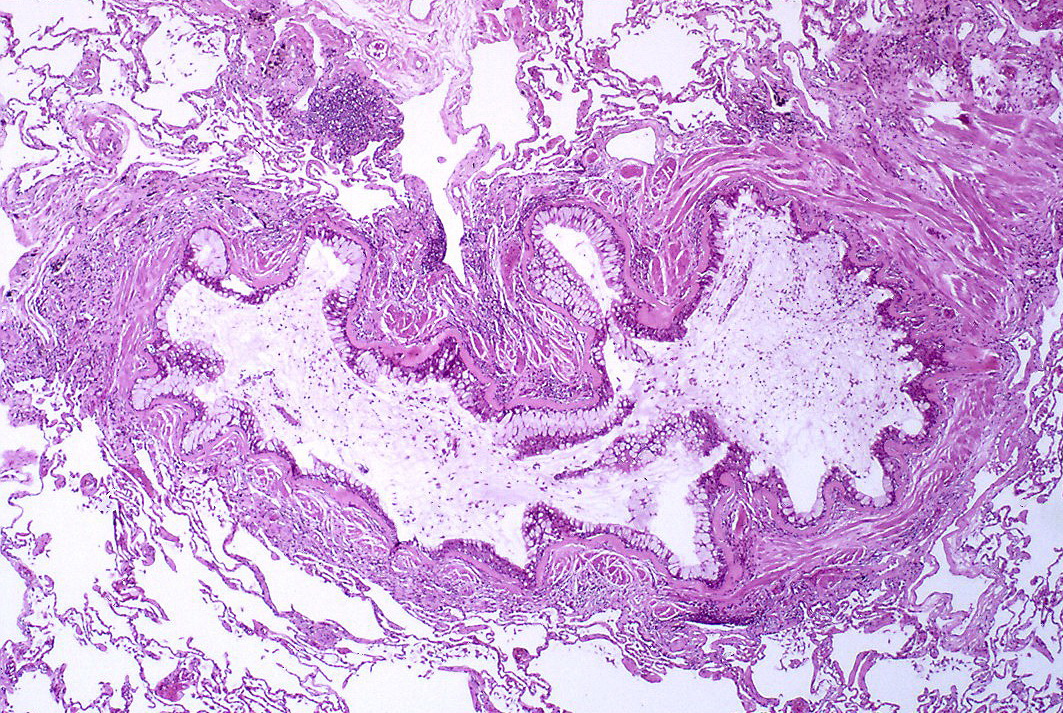
Original TriageTrail teaching diagram. Use with the explanatory text and current clinical guidance.Asthma-affected bronchiole histopathology. Yale Rosen / Pulmonary Pathology, Wikimedia Commons, CC BY-SA 2.0. Image unmodified.
Airway anatomy and physiology
Air moves from the trachea through branching bronchi and bronchioles to the alveoli. Bronchial smooth muscle can constrict, the mucosal lining can become inflamed and oedematous, and mucus can narrow the lumen. Because resistance rises sharply as airway radius falls, a modest reduction in calibre can substantially increase the work of breathing.
Variability and reversibility
Asthma commonly varies over time and with triggers. Cough, wheeze, breathlessness and chest tightness may fluctuate by day, night, season, exposure and treatment. A normal examination between episodes does not exclude asthma. Persistent or atypical symptoms require consideration of other respiratory, cardiac, upper-airway and functional causes.
Inflammation and bronchoconstriction are related but distinct
Bronchoconstriction can change quickly; airway inflammation and future exacerbation risk may persist when the person feels well. This distinction explains why symptom relief alone does not describe the whole condition or future risk.
Key points
Asthma is characterised by variable respiratory symptoms and variable expiratory airflow limitation. Symptoms and examination can vary, so a label should not be confirmed or rejected from one feature alone.
New or severe breathing difficulty requires the current urgent or emergency route; do not delay for a complete diagnostic work-up.
What is the safest description of asthma at foundation level?
LESSON 03 · 30 MINUTES
Focused history, pattern and context
Core concept
Clarify onset, frequency, variability, night waking, exercise or work relationship, triggers, functional effect, smoking or vaping exposure, comorbidities, previous attacks, urgent care, admissions and current medicines as appropriate to role.
Worked example
Symptoms improve on days away from work. Record the occupational pattern and route it for appropriate specialist assessment rather than declaring the cause.
Applied activity
Build a timeline for a fictional presentation and mark facts that affect current urgency, diagnostic assessment and longer-term risk.
Safety boundary
A familiar history of asthma does not make every episode asthma; assess the current presentation and alternative time-critical causes within scope.
Original TriageTrail teaching diagram. Use with the explanatory text and current clinical guidance.
Start with present safety
Observe speech, posture, work of breathing, respiratory rate, pulse, oxygen saturation where available, mental state and overall trajectory. Severe breathlessness, exhaustion, cyanosis, poor respiratory effort, altered consciousness or inability to speak normally requires urgent emergency assessment; do not delay to finish a routine history.
Build a symptom timeline
Clarify onset, frequency, duration and variability of wheeze, cough, chest tightness and breathlessness. Ask about night waking, early-morning symptoms, exercise, cold air, viral illness, pollen, animals, smoke, vaping, workplace exposures and medicines. Establish symptom-free intervals and response to the current agreed plan without using response alone as proof of diagnosis.
Examination and alternatives
Assess general appearance and observations, then inspect breathing pattern and chest movement, palpate and percuss where indicated, and auscultate systematically within competence. Expiratory polyphonic wheeze may support airflow obstruction, but a silent chest in a very unwell person is dangerous. Consider infection, anaphylaxis, pulmonary embolism, pneumothorax, cardiac disease, inducible laryngeal obstruction, dysfunctional breathing and foreign body according to context.
Occupational and environmental pattern
For adult-onset or poorly controlled disease, ask whether symptoms improve away from work, on weekends or holidays. Record the answer and use the appropriate occupational-asthma referral route rather than advising the person to leave work without specialist assessment.
Key points
Clarify onset, frequency, variability, night waking, exercise or work relationship, triggers, functional effect, smoking or vaping exposure, comorbidities, previous attacks, urgent care, admissions and current medicines as appropriate to role.
A familiar history of asthma does not make every episode asthma; assess the current presentation and alternative time-critical causes within scope.
Clinical history establishes suspicion; the current age-appropriate NICE pathway uses objective evidence such as eosinophils, FeNO, spirometry with bronchodilator reversibility, peak-flow variability or specialist challenge in a defined sequence.
Core concept
Each test answers a bounded question and depends on technique, timing, reference values and context. One result should not be stretched beyond its role.
Worked example
A single patient-owned peak-flow value without a verified personal baseline, technique or trend is described as one reported measurement, not confirmation or exclusion of asthma.
Safety boundary
This course does not teach diagnostic thresholds or practical testing. Use the live guideline and trained supervision.
Original TriageTrail teaching diagram. Use with the explanatory text and current clinical guidance.
Why objective confirmation matters
Current NICE guidance says not to confirm asthma without both a suggestive clinical history and supporting objective evidence. Record suspected asthma until confirmed, and record the basis for a confirmed diagnosis.
What the tests contribute
Blood eosinophils and fractional exhaled nitric oxide provide evidence of type 2 airway inflammation in the correct pathway. Spirometry measures volumes and flows; bronchodilator reversibility assesses change after bronchodilator. Twice-daily peak expiratory flow over a defined period can demonstrate variability when spirometry is unavailable or delayed. Bronchial challenge is a specialist option when suspicion remains.
Quality and timing
Every result depends on correct identity, preparation, technique, calibration, reference values, units, timing and treatment status. Inhaled corticosteroid treatment may make spirometry or FeNO results more likely to be normal. Acute illness should be treated promptly; objective testing follows when safe and feasible.
Adult pathway: what each step establishes
For an adult with a history suggestive of asthma, current NG245 starts with blood eosinophils or FeNO. If neither confirms asthma, it moves to bronchodilator reversibility with spirometry. Where spirometry is unavailable or delayed, it uses twice-daily PEF over 2 weeks. If asthma remains clinically suspected after these steps, the guideline directs referral for consideration of bronchial challenge. This is a sequence for appropriately trained clinicians and quality-assured services; this course teaches how to understand and document the pathway, not how to perform or independently interpret the tests.
Numbers are not a diagnosis by themselves
Each threshold belongs to a defined age group, test method, time point and clinical history. Record the test used, date, pre-test treatment, technical limitations, result units and source report. A learner should not copy a number from a course into a patient record or apply it outside the current guideline.
Reconciling apparently conflicting evidence
It is possible for a persuasive history and an individual objective test not to align. Before drawing a conclusion, check inhaled corticosteroid use, activity of symptoms around the test date, test acceptability and whether the age-appropriate sequence was completed. Record uncertainty and agree the next owner rather than writing “normal, therefore no asthma”.
Minimum data set for referral or review
Include symptom pattern and functional impact; current urgency; relevant observations; test name, date, result and quality comment; medication and adherence context; previous attacks and urgent care; important differentials; and the question being asked of the receiving clinician.
When symptoms are acute
People who are acutely unwell or highly symptomatic need prompt assessment and treatment through the appropriate route. If objective tests cannot be completed then, the guidance is to arrange them once symptoms are controlled and advise the person to seek help if they deteriorate while waiting.
Current adult NICE sequence
At the time of this draft, NG245 begins with eosinophils or FeNO, then bronchodilator reversibility, then two-week PEF variability if needed, with specialist bronchial challenge when asthma remains suspected. Learners must check the live guideline because thresholds and sequencing can change.
Key points
Clinical history establishes suspicion; the current age-appropriate NICE pathway uses objective evidence such as eosinophils, FeNO, spirometry with bronchodilator reversibility, peak-flow variability or specialist challenge in a defined sequence.
This course does not teach diagnostic thresholds or practical testing. Use the live guideline and trained supervision.
Current symptom control and future attack risk overlap but are not identical. Review symptoms, night waking, function, time off work or school, reliever use, oral corticosteroid courses, urgent care or admissions, adherence and technique.
Worked example
A person reports few current symptoms but several urgent-care contacts in the last year. Do not describe risk as low from today’s symptom report alone.
Applied activity
Review a fictional record and identify missing control evidence, risk history, prescription pattern, technique check and action-plan review.
Safety boundary
Increasing reliever use or failure to collect anti-inflammatory treatment is a safety signal requiring timely review under current guidance.
Original TriageTrail teaching diagram. Use with the explanatory text and current clinical guidance.
Control and risk are not interchangeable
Current symptoms describe recent burden; future attack risk also depends on previous attacks, oral corticosteroid courses, emergency attendance, hospital admission, reliever use, adherence, treatment collection and other risk factors. Few symptoms today do not erase a serious history.
Structured review dataset
Review daytime and night symptoms, activity and absence from work or school, reliever use, oral corticosteroid courses, urgent care and admissions. Check prescriptions, adherence, inhaler technique, smoking or vaping, occupational and environmental exposure, comorbidity, vaccination and the current personalised action plan within role.
Recognise risk signals
NICE recommends actively identifying people at risk of poor outcomes. Its listed signals include non-adherence, more than two SABA inhalers per year, two or more oral corticosteroid courses per year, two or more emergency-department visits, or any asthma hospital admission. These trigger structured clinical review; they are not a substitute for assessing the person.
After an exacerbation
Follow-up should examine what happened, whether the diagnosis and regimen remain appropriate, technique, adherence, exposures and whether the action plan worked. Responsibility and timing for the next review must be explicit.
Key points
Current symptom control and future attack risk overlap but are not identical. Review symptoms, night waking, function, time off work or school, reliever use, oral corticosteroid courses, urgent care or admissions, adherence and technique.
Increasing reliever use or failure to collect anti-inflammatory treatment is a safety signal requiring timely review under current guidance.
An inhaler is both medicine and device. Record the actual device and medicine, intended role, observed technique, dose-counter understanding, preferences, barriers and whether prescriptions are collected, within authorised role.
Core concept
Ask about adherence without blame. Explore understanding, benefit, concerns, side effects, routine, cost or access and device capability before assuming unwillingness.
Worked example
A learner notices repeated reliever requests and no recorded technique review. The safe response is governed clinical review, not an independent medicine change.
Safety boundary
AIR, MART, preventer and reliever terms depend on the actual prescribed regimen. Never infer instructions from inhaler colour.
Original TriageTrail teaching diagram. Use with the explanatory text and current clinical guidance.Spacer and inhaler demonstration. Tradimus, Wikimedia Commons, CC BY-SA 3.0. Image unmodified.
American Lung Association. Device instructions and UK prescribing context still take precedence.
Medicine and device form one intervention
Record the exact medicine, strength, device and prescribed role. Terms such as preventer, reliever, AIR and MART describe clinical roles or regimens; colour cannot safely identify them. AIR uses an anti-inflammatory reliever, while MART uses one ICS/formoterol inhaler for maintenance and relief under a prescribed plan.
Technique differs by device
Pressurised metered-dose inhalers usually require coordinated slow inhalation and may use a spacer. Dry-powder inhalers depend on an adequate forceful inhalation. Breath-actuated and soft-mist devices have their own preparation and delivery steps. Always use the manufacturer’s current instructions and observe the person using their actual device.
A reproducible technique check
Confirm device preparation, posture, exhalation away from the device, mouth seal, inhalation pattern, breath hold when appropriate, dose counter and cleaning or storage. Ask the person to demonstrate again after feedback. Practical competence requires device-specific supervised assessment.
Adherence without blame
Ask what the person understands, what they actually do, what helps and what gets in the way. Explore perceived benefit, fear of adverse effects, dexterity, cognition, routine, stigma, school or work, supply and cost. Compare the conversation with prescription records where appropriate.
An inhaler is both medicine and device. Record the actual device and medicine, intended role, observed technique, dose-counter understanding, preferences, barriers and whether prescriptions are collected, within authorised role.
AIR, MART, preventer and reliever terms depend on the actual prescribed regimen. Never infer instructions from inhaler colour.
Why is inhaler colour an unsafe way to give instructions?
LESSON 07 · 30 MINUTES
Personalised action plans and self-management
Core concept
A written personalised action plan connects usual treatment, monitoring, recognition of worsening, clear actions, review and emergency help. It belongs to the person’s clinical care and must match their current regimen.
Worked example
A generic handout conflicts with the current prescription. Stop and route the discrepancy to an appropriate clinician; do not edit either plan independently.
Applied activity
Audit a fictional action plan for identity/version, usual plan, worsening signs, specific routes, accessibility, understanding and review date without supplying medicine doses.
Safety boundary
Course content is not an action plan. Learners must use the person’s current approved plan and emergency route.
Original TriageTrail teaching diagram. Use with the explanatory text and current clinical guidance.
What an action plan does
A written personalised action plan connects the person’s usual treatment, monitoring, recognition of deterioration, agreed actions, emergency route and review. It must match the current prescription and the person’s abilities and preferences.
Make the plan usable
Use plain language, accessible format and specific instructions. Identify personal triggers and whether monitoring is symptom-based, peak-flow based or both. Record who to contact, when to seek urgent help and what to do if the usual service is unavailable.
Teach-back
Ask the person to explain what they will do when well, when symptoms worsen and when urgent help is needed. Correct misunderstandings without blame. Review the plan after acute consultations, hospital attendance and at routine reviews, and whenever treatment changes.
Resolve discrepancies
If a printed plan, medication list and current prescription disagree, stop and ask the responsible clinician to reconcile them. Do not independently rewrite doses or directions outside role.
Key points
A written personalised action plan connects usual treatment, monitoring, recognition of worsening, clear actions, review and emergency help. It belongs to the person’s clinical care and must match their current regimen.
Course content is not an action plan. Learners must use the person’s current approved plan and emergency route.
What is the purpose of a personalised asthma action plan?
LESSON 08 · 30 MINUTES
Deterioration, attacks and escalation
Core concept
Assess current breathing, speech, function, trajectory, response to the person’s plan, available observations and signs of exhaustion or altered consciousness within role. A device number cannot replace the whole presentation.
Worked example
A person cannot complete normal sentences and is worsening despite following their plan. Activate the current emergency route rather than continuing a routine review.
Applied activity
Practise an escalation handover stating current concern, change, evidence, limits, action already taken under the plan and requested response.
Safety boundary
Do not delay emergency help while looking for every feature, calculating an educational score or completing course questions.
Original TriageTrail teaching diagram. Use with the explanatory text and current clinical guidance.
An asthma attack is a clinical emergency spectrum
Assess the person, not a single number. Worsening symptoms, increasing reliever use, inability to perform usual activity, difficulty speaking, marked work of breathing, exhaustion, poor air entry, cyanosis, altered consciousness or deteriorating observations require urgent escalation according to the current pathway.
Numbers have limits
Peak flow is effort- and technique-dependent and should be compared with a reliable personal best or predicted value only within the relevant pathway. Oxygen saturation may be misleading with poor signal or perfusion. A reassuring value does not overrule a severely unwell appearance.
Immediate priorities
Use an A–E approach, activate help early, follow the personalised plan and local emergency protocol within scope, and repeat observations while awaiting transfer. Treatment algorithms, medicine doses and prescribing decisions sit in the live emergency guideline and authorised local protocol rather than this foundation course.
Structured handover
State identity, immediate concern, symptom trajectory, observations, examination, relevant history, current treatment and response, assessment limitations and the action requested. Confirm who accepts responsibility and what happens if transfer is delayed.
Review control and risk separately
At every asthma review, current NG245 says to consider symptoms alongside time off work or school, reliever use and prescription record, oral corticosteroid courses, emergency-department attendance and hospital admissions. A person may report few day-to-day symptoms yet still have a concerning history. Use a validated symptom questionnaire only as one part of the review, not as a substitute for the wider record.
Structured pre-escalation check
Before a treatment decision is made by an authorised prescriber, the clinical review needs a clear account of diagnosis evidence, current symptoms and attacks, adherence, actual device technique, exposure and comorbidity, prescribed versus collected medicines, and the person’s priorities. This course does not teach a dosing algorithm. It teaches the information needed for safe handover and review.
Key points
Assess current breathing, speech, function, trajectory, response to the person’s plan, available observations and signs of exhaustion or altered consciousness within role. A device number cannot replace the whole presentation.
Do not delay emergency help while looking for every feature, calculating an educational score or completing course questions.
A person cannot complete sentences and is worsening despite their plan. What is safest?
LESSON 09 · 30 MINUTES
Documentation, partnership and next steps
Core concept
A defensible record separates reported symptoms, observed and measured evidence, technique/adherence discussion, risk history, assessment limits, plan review, agreed action, escalation, ownership and follow-up.
Core concept
Shared decisions require accessible information, options within the authorised decision, preferences, uncertainty and a check of understanding. Agreement does not remove the need to address unsafe deterioration.
Reflection
Using only synthetic information, identify one assumption you would avoid, one supervision need and one source or local pathway to check.
Safety boundary
Suspected medicine or device problems follow local governance and, where appropriate, the MHRA Yellow Card route; urgent clinical care takes priority.
Original TriageTrail teaching diagram. Use with the explanatory text and current clinical guidance.
Document the evidence trail
Separate reported symptoms from observed findings and device records. Record technique, timing, treatment status and limitations for objective tests. Note the basis for suspected or confirmed asthma and avoid copying an unsupported historic label forward.
Partnership and inclusion
Use shared decision making, interpreters and reasonable adjustments. For children and young people, include developmental capacity, family or carer involvement, school use and transition needs while preserving the young person’s voice and confidentiality.
Pregnancy, smoking and vaping
Asthma should be reviewed in early pregnancy and postpartum. Current guidance emphasises maintaining good control and continuing prescribed asthma medicines. Ask about smoking and vaping and route to appropriate cessation support. Individual treatment decisions remain with an authorised clinician using current guidance.
Quality improvement
Audit diagnostic evidence, action-plan coverage, technique checks, reliever overuse, oral corticosteroid courses, emergency attendance and post-attack reviews. Report suspected medicine or device safety problems through local governance and the MHRA Yellow Card route where appropriate.
Development plan
Completion demonstrates online knowledge only. Record what practical skills require supervised observation, which current pathway applies to your role and when you will seek reassessment of competence.
Key points
A defensible record separates reported symptoms, observed and measured evidence, technique/adherence discussion, risk history, assessment limits, plan review, agreed action, escalation, ownership and follow-up.
Suspected medicine or device problems follow local governance and, where appropriate, the MHRA Yellow Card route; urgent clinical care takes priority.
Fractional exhaled nitric oxide (FeNO) is a non-invasive measurement that can support assessment of type 2 airway inflammation. Blood eosinophils are a laboratory measure of an inflammatory cell type. Neither result is a generic “asthma score”. Their place is in the age-appropriate diagnostic and monitoring pathway alongside a suggestive history, examination, treatment status and test quality.
Before treating a result as evidence
Identify the exact test, date, units, laboratory or device, reference interval or reporting threshold, current inhaled corticosteroid exposure, recent respiratory illness and technical comments. A normal result does not erase a concerning history, and an elevated result does not explain every breathlessness presentation. The responsible clinician must apply the live guideline and local service pathway.
How to hand over objectively
A clear handover distinguishes: “history suggests variable symptoms”, “FeNO/eosinophils were measured”, “this was the result and context”, and “this is the decision or review requested”. Do not write that a result confirms a diagnosis unless the authorised decision maker has applied the appropriate pathway.
Worked case
A fictional adult has variable nocturnal cough, a current inhaled corticosteroid prescription and a FeNO result reported as normal. List the additional history, treatment and test-context information that must be visible before the result is discussed at review.
Spirometry measures forced expiratory manoeuvres, including FEV1 and FVC. Bronchodilator reversibility compares measurements before and after bronchodilator in the defined pathway. PEF is a single maximal flow effort; a two-week record may demonstrate variability when collected correctly. Each has technique and quality requirements and each has limits.
Reading a report before reasoning from it
Confirm identity, date, indication and whether the person was symptomatic.
Read any quality or acceptability statement before looking at values.
Check pre- and post-bronchodilator status, treatment withholding instructions and whether these were followed.
Read units, reference set and reported interpretation.
Record what remains uncertain and who is responsible for formal interpretation.
Inhaler. Fatimah Bello, Wikimedia Commons, CC0. Image unmodified; it does not identify a medicine or instruct on use.
Peak-flow records are a series, not a single number
A useful PEF diary has a specified schedule, repeated measurements, a clear choice of the best reading, dates and times, symptoms, treatment context and any missed entries. A single patient-reported value cannot establish variability or exclude a time-critical alternative diagnosis. Practical coaching and device quality assurance require appropriate training.
Safety boundary
Do not ask a visibly unwell person to perform repeated manoeuvres in place of urgent assessment. Follow the local respiratory testing and emergency pathway.
Worked case
A fictional diary includes one evening reading on three days, no technique record and no timing. Explain why it cannot be treated as a complete diagnostic PEF record.
What should be checked before interpreting a spirometry report?
LESSON 12 · 35 MINUTES
Devices, technique and adherence in practice
Device choice is person-specific
Current guidance places correct technique, the person’s preference, environmental impact and an integral dose counter within inhaler choice. A device cannot be selected safely by colour, a generic “best inhaler” list, or assumed competence. Choice and prescribing remain the responsibility of the authorised clinician and local formulary process.
Asthma inhaler. NIAID, Wikimedia Commons, CC BY 2.0. Image unmodified; illustrative only and not a device-selection guide.
A structured technique conversation
Invite the person to show what they usually do using their own device or a placebo device. Observe preparation, exhalation before the dose where appropriate, seal and inhalation, coordination or inspiratory effort, breath hold where appropriate, repeat doses, spacer care and aftercare. Use the manufacturer’s current instructions and a trained assessor; avoid correcting technique from memory alone.
Adherence is not a moral judgement
Explore whether the person has access to medicines, understands the regimen, has concerns about adverse effects, uses the device in public, can physically operate it, has a workable routine and has received conflicting instructions. Compare prescribed, dispensed and reported use carefully. “Non-compliance” is not an adequate clinical explanation.
Common technique-review failures to look for
Failures may include an empty device, incorrect preparation, poor seal, unsuitable inspiratory pattern, poor coordination, omitted breath hold, omitted spacer where intended, or inadequate cleaning and storage. The response is supportive retraining against current device instructions and local process, followed by re-demonstration when this is within role and competence.
Accessibility and communication
Technique teaching may need large print, translation, hearing support, simplified written steps, a carer’s involvement where appropriate, or repeated short demonstrations. Ask how the person prefers to learn and document the adjustment; an information leaflet alone does not establish usable technique.
Worked case
A fictional person says they use the “blue inhaler when needed” but cannot name the device and has not brought it. Write three questions that improve safety without guessing the medication.
What is the safest first step in an inhaler-technique review?
LESSON 13 · 35 MINUTES
Children, pregnancy and occupational asthma
Age changes the pathway
Children and young people need an age-appropriate assessment, objective-testing pathway, communication approach and involvement of parents or carers. Under-fives have a separate pathway. Do not import adult thresholds or testing assumptions into paediatric care; use the current guideline and local paediatric service.
Pregnancy and breastfeeding
Good asthma control remains important in pregnancy and after birth. The course does not advise individual medicine changes. Promptly route questions about prescribed treatment, deterioration, safety concerns or planned changes to the responsible maternity and respiratory care team using current guidance.
Work-related patterns
For adult-onset asthma, return of childhood asthma or poor control, ask whether symptoms change on work days, rest days, weekends, holidays or between shifts. Record the answers precisely. Suspected occupational asthma needs specialist assessment; casual advice to leave work or continue exposure without assessment can cause harm.
Worked case
A fictional adult’s symptoms improve during annual leave but return after several shifts involving dust exposure. Identify the documentation and referral issue without declaring occupational asthma.
What is the right response to a possible occupational pattern?
LESSON 14 · 35 MINUTES
Post-attack review and service improvement
After an attack: reconstruct what happened
A post-attack review should clarify the trajectory, emergency contacts, treatment actually used, adherence and technique, written action plan, trigger or exposure, diagnostic certainty, follow-up ownership and the person’s account of barriers. The aim is not to find blame; it is to reduce repeat risk through a documented, person-centred plan within the correct clinical governance.
Risk stratification in a practical record
Current NG245 identifies factors such as non-adherence, high SABA use, repeated oral corticosteroid courses, emergency attendance and hospital admission as prompts to identify people at risk of poorer outcomes. Capture the evidence source and date. An online learner must escalate identified concern to the appropriate team rather than change treatment independently.
Learning at system level
Services can audit whether diagnosis evidence is recorded, post-attack reviews occur, action plans are current, technique is observed, and high-risk patterns are followed up. A useful audit asks whether the record supports the action taken, whether access barriers are visible and whether learning has been fed back to the team.
Worked record-review exercise
For each fictional post-attack record, mark evidence as present, absent or uncertain. Then write one safety-net statement with a named follow-up owner. This develops a documentation skill rather than retrospective opinion.
When to seek senior or specialist input
Escalate in line with local policy when there is diagnostic uncertainty, recurrent urgent care, a suspected work-related component, possible medicine or device safety issue, severe or worsening symptoms, or barriers that make the agreed plan unsafe or unworkable.
Worked case
A fictional record states “reviewed after attack” but has no action-plan check, inhaler demonstration, follow-up owner or account of the event. Identify four missing elements.
Airway physiology in depth: linking symptoms to function
The airway is a branching system
The trachea divides into progressively smaller bronchi and bronchioles. Larger airways contribute most to bulk flow; smaller airways can become important sites of inflammation and narrowing. Alveoli are the gas-exchange units beyond the conducting airways. A person can feel chest tightness, cough, wheeze or breathlessness for different reasons, so the symptom alone does not tell you which anatomical process is dominant.
Why narrowing changes the work of breathing
When the airway lumen narrows, airflow resistance rises. During expiration, intrathoracic pressure and dynamic airway compression can make it harder to move air out, especially when obstruction is present. The person may prolong expiration, recruit accessory muscles, sit forward or speak in shorter phrases. These are observations requiring context, repeated assessment and escalation where appropriate; they are not a diagnostic shortcut.
Inflammation, smooth muscle and mucus
Asthma involves variable airway inflammation and hyper-responsiveness. Bronchial smooth muscle constriction, mucosal swelling and mucus can coexist and vary over time. This helps explain why someone can experience a rapid change in symptoms, why a normal interval examination does not exclude asthma and why symptom relief does not necessarily describe future attack risk.
Ventilation is not the same as oxygenation
Ventilation refers to movement of air; oxygenation concerns oxygen transfer to blood. Pulse oximetry can be useful where available, but it has technical and clinical limits. A reassuring device reading never replaces the whole assessment of appearance, speech, respiratory effort, trajectory and consciousness. Poor signal, perfusion, movement, nail products and device limitations can all affect reliability.
Worked case
A fictional person is speaking in short phrases, sitting forward and looks exhausted, but reports that their home pulse-oximeter shows a reading they believe is “okay”. Identify why escalation cannot wait for a course calculation or a longer history.
Why can a normal interval examination not exclude asthma?
LESSON 16 · 45 MINUTES
Differentials and diagnostic safety
Start with the presentation, not the existing label
A previous asthma diagnosis may be correct, incomplete, historic or unrelated to today’s problem. New, atypical or severe symptoms require a fresh assessment within scope. The task is not to generate an exhaustive differential from memory; it is to recognise time-critical alternatives, gather relevant evidence and use the right escalation route.
Respiratory, cardiac and upper-airway alternatives
Depending on age and context, consider respiratory infection, pneumonia, pneumothorax, pulmonary embolism, anaphylaxis, foreign body, upper-airway obstruction or inducible laryngeal obstruction. Cardiac causes, pulmonary oedema, anaemia, dysfunctional breathing, anxiety and medicine effects may also contribute to breathlessness. Features overlap. A course cannot diagnose these conditions: the learner must describe observed facts, uncertainty and urgency to the responsible clinician.
Red flags that change urgency
Escalate promptly for severe or rapidly worsening breathlessness, exhaustion, cyanosis, reduced consciousness, poor respiratory effort, chest pain with concerning features, syncope, suspected anaphylaxis, unilateral pleuritic symptoms where pulmonary embolism or pneumothorax is a concern, or any presentation that appears seriously unwell. The relevant emergency pathway takes priority over lung-function tests, routine review or course activity.
A useful reasoning record
Document the person’s baseline and change from baseline, onset and trigger, observations and examination findings, relevant negative findings, treatment already used and response, limitations of the assessment, differential concerns and the explicit action requested. Avoid saying “it is anxiety” or “it is asthma” when the evidence is incomplete.
Worked case
A fictional person with asthma reports sudden unilateral chest pain and new breathlessness after a long journey. Write a one-sentence escalation handover that does not assume the cause.
Primary source: NICE NG245 recommendations; use current emergency and local differential-diagnosis guidance.
Check your understanding
What is the safest approach when a person with asthma has a new atypical presentation?
LESSON 17 · 40 MINUTES
Remote review and safety-netting
Remote assessment begins with capability
Before relying on a remote review, establish identity, location, call-back number, ability to communicate, presence of another adult where relevant, language or communication needs, and whether the technology is sufficient for the clinical concern. If a person may be critically unwell, the remote consultation must move to the emergency route rather than attempt a comprehensive virtual examination.
What can and cannot be observed remotely
You may be able to observe speech, work of breathing, posture, colour, alertness, visible distress and change over the call. You may not be able to reliably assess chest signs, device readings, environment or all observations. Ask what is measured, how, when and by whom. State the limitation in the record and set a lower threshold for face-to-face assessment or escalation where uncertainty is material.
Safety-netting that works
Specific safety-netting states the concern, what change triggers action, the route to use, how urgently to use it, what to do if the route fails, and who is responsible for follow-up. “Seek help if worse” is inadequate because it leaves “worse” and “help” undefined. Check back the person’s understanding using their own words.
Remote documentation template
Reason for contact and current severity.
Identity, exact location and contact plan.
Observed features and any self-reported readings with their limitations.
Relevant history, current plan and medicine/device information.
Risk, uncertainty, disposition and named follow-up owner.
Worked case
A fictional caller becomes more breathless, cannot speak in normal sentences and says they are alone. Draft a safe remote escalation sequence within your role.
Clinical scope and remote-consultation policy vary by employer and setting. Use current local governance alongside NICE NG245.
Check your understanding
What should specific safety-netting include?
LESSON 18 · 40 MINUTES
Self-management, action plans and health literacy
A written plan is a shared clinical tool
A personalised asthma action plan is developed for an individual by the responsible clinical team. It should be current, understandable and usable in the person’s everyday setting. It supports usual management, recognition of deterioration and urgent action, but it does not replace review when symptoms are severe, atypical or worsening.
Check understanding, not agreement
Asking “do you understand?” often produces a polite yes. Use teach-back: ask the person to describe what they would do on a usual day, with early deterioration and in an emergency. This reveals unclear wording, literacy issues, language needs, competing advice and practical barriers before they become safety problems.
Working with families, schools and carers
For children and young people, include developmentally appropriate communication, consent and confidentiality, the child’s own voice, parental or carer involvement, and school or workplace arrangements where relevant. Do not distribute a plan without confirming it is the current agreed version and that the person knows where it is kept.
Health inequality and access
Consider cost, prescription collection, transport, digital exclusion, health literacy, housing exposures, smoking or vaping, stress, work patterns and culturally appropriate support. These are not side issues: they may decide whether a plan can be followed. Escalate barriers to the appropriate team rather than framing them as lack of motivation.
Worked case
A fictional person agrees with their plan but cannot read the small print, shares a phone with family and has missed repeat prescriptions because of transport. Identify three reasonable adjustments or supports to discuss with the responsible team.
Some people have persistent symptoms, recurrent attacks, frequent urgent care, significant treatment burden, possible occupational exposure, multiple comorbidities or uncertainty around diagnosis. “Difficult to treat” is not a diagnosis. It is a prompt to check evidence, treatment access, adherence, technique, exposures, comorbidities, differential diagnoses and the need for specialist review.
Comorbidity changes the conversation
Rhinitis, reflux symptoms, obesity, smoking or vaping, anxiety, dysfunctional breathing, sleep issues and cardiac disease can interact with respiratory symptoms and treatment experience. The course does not prescribe for these conditions. It teaches the learner to describe the relevant pattern, avoid simplistic attribution and involve the appropriate service.
Multidisciplinary contributions
General practice, respiratory medicine, pharmacy, specialist nursing, physiotherapy, occupational health, maternity care, paediatrics, mental-health services and social or community support may each contribute. Good coordination names the responsible clinician, the current plan, outstanding tests, referral question and review date. Avoid duplicating conflicting instructions across teams.
Quality of life is a clinical outcome
Ask about sleep, exercise, employment, education, caring, intimacy, confidence, avoidance and mental wellbeing. A technically “acceptable” result may not mean the person is coping. Equally, a person who appears to cope may be overusing reliever medication or avoiding activity. Bring both evidence and lived experience into the review.
Worked case
A fictional person has repeated urgent-care visits, low confidence using devices, allergic rhinitis and night-shift work. Build a multidisciplinary review question without suggesting a prescription.
Work through all eight fictional cases. For each, identify immediate safety, information still required, the meaning and limits of available evidence, disposition, communication and documentation.
Symptoms absent today
A fictional student reports variable night cough and episodic wheeze but has no symptoms during the appointment.
Reveal the guided debrief
The case assesses bounded reasoning, communication and escalation. It does not assess diagnosis, treatment selection, prescribing or practical competence.
Required output: Write a short structured handover and safety net without adding medicine doses or identifiable information.
The workplace pattern
A fictional adult reports symptoms during shifts that improve on weekends and holidays.
Reveal the guided debrief
The case assesses bounded reasoning, communication and escalation. It does not assess diagnosis, treatment selection, prescribing or practical competence.
Required output: Write a short structured handover and safety net without adding medicine doses or identifiable information.
One home peak-flow value
A fictional caller reports one peak-flow number without technique, personal baseline, timing or a verified device.
Reveal the guided debrief
The case assesses bounded reasoning, communication and escalation. It does not assess diagnosis, treatment selection, prescribing or practical competence.
Required output: Write a short structured handover and safety net without adding medicine doses or identifiable information.
Quiet symptoms, serious history
A fictional person reports little current limitation but has repeated reliever requests and two urgent-care contacts in the last year.
Reveal the guided debrief
The case assesses bounded reasoning, communication and escalation. It does not assess diagnosis, treatment selection, prescribing or practical competence.
Required output: Write a short structured handover and safety net without adding medicine doses or identifiable information.
The inhaler colour shortcut
A fictional handover identifies medicines only as “the blue one” and “the brown one”; actual devices and regimen are unclear.
Reveal the guided debrief
The case assesses bounded reasoning, communication and escalation. It does not assess diagnosis, treatment selection, prescribing or practical competence.
Required output: Write a short structured handover and safety net without adding medicine doses or identifiable information.
Conflicting action plans
A fictional patient has an older printed action plan that does not match the current prescription record.
Reveal the guided debrief
The case assesses bounded reasoning, communication and escalation. It does not assess diagnosis, treatment selection, prescribing or practical competence.
Required output: Write a short structured handover and safety net without adding medicine doses or identifiable information.
Worsening during a remote review
A fictional remote patient is increasingly breathless and cannot complete normal sentences despite following their current plan.
Reveal the guided debrief
The case assesses bounded reasoning, communication and escalation. It does not assess diagnosis, treatment selection, prescribing or practical competence.
Required output: Write a short structured handover and safety net without adding medicine doses or identifiable information.
The incomplete review record
A fictional annual-review note says “controlled” but contains no risk history, technique observation, prescription pattern or action-plan check.
Reveal the guided debrief
The case assesses bounded reasoning, communication and escalation. It does not assess diagnosis, treatment selection, prescribing or practical competence.
Required output: Write a short structured handover and safety net without adding medicine doses or identifiable information.
Video and technique resource shelf
Open these resources in a separate tab. They supplement, but never replace, current device instructions, local policy and observation by an appropriately trained assessor.
Video resources are optional supplementary learning. Check their publisher, date and local relevance before using them in clinical practice.
Clinical review note: A named clinician must review this course, its questions and the live linked guidance before learner release. Local pathways, scopes of practice and product information take precedence.
Check your understanding
A person cannot complete sentences and is worsening despite their plan. What is safest?